
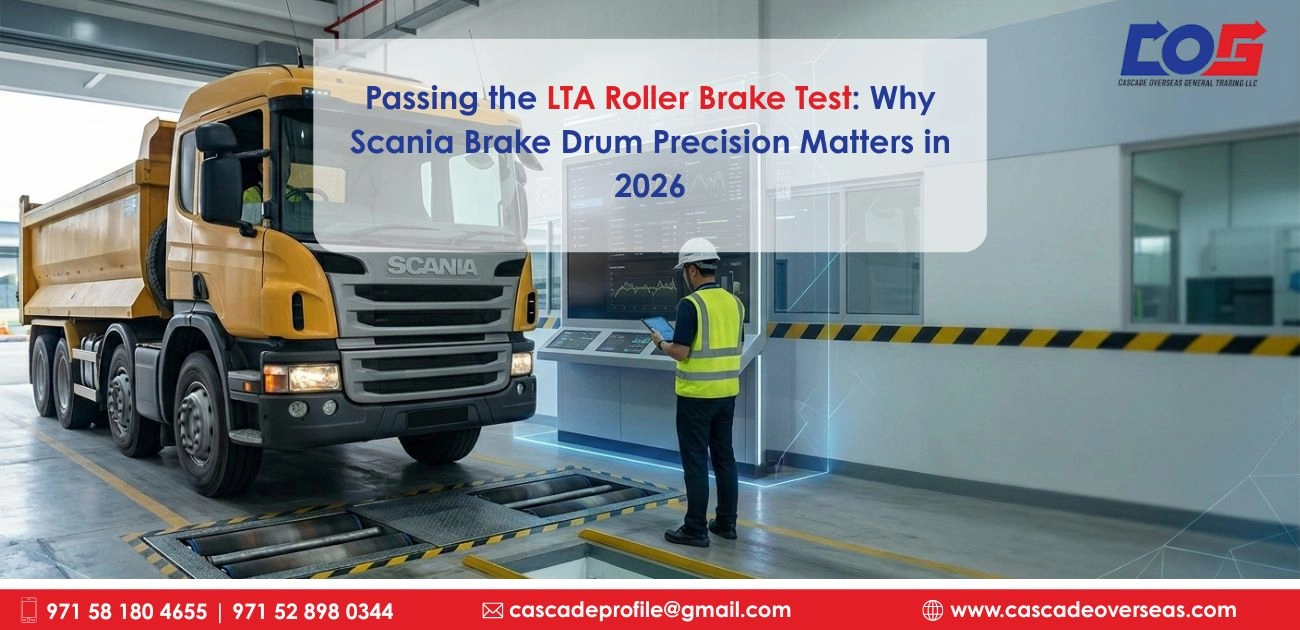
For fleet owners in Singapore, few things are as stressful as the mandatory LTA Periodic Inspection. Whether you are heading to VICOM, STA, or JIC, the stakes are high. A “FAIL” result doesn’t just mean a small fine; it leads to immediate vehicle downtime, costly re-test fees, and delays in road tax renewal that can ground your entire operation.
The most common point of failure for heavy vehicles like the Scania P380 and Scania R440 is the Roller Brake Test (RBT). Often, the root cause is a significant Brake Drum Imbalance LTA inspectors will flag—driven by “invisible wear” or damage inside the drum that you simply can’t see during a basic walk-around. Passing the RBT in 2026 isn’t just about having working brakes; it’s about the mechanical precision of your brake drums.
1. Understanding the LTA Roller Brake Test (Key Metrics)
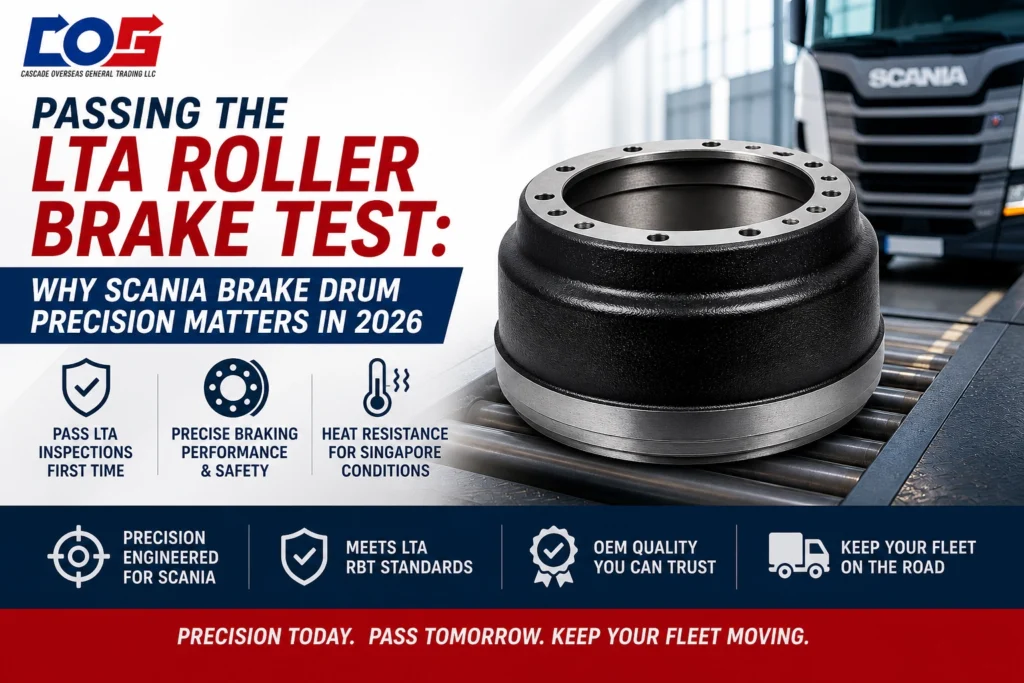
To pass the inspection, your truck must meet strict digital benchmarks measured by LTA sensors. If your drums are out of spec, the machines will catch it instantly.
- Braking Efficiency: This measures the total stopping force relative to your vehicle’s weight. For heavy goods vehicles (HGVs), the service brake must meet the legal percentage threshold. Worn drums with thin walls cannot sustain the pressure needed to hit these numbers.
- Brake Imbalance (The Silent Killer): The LTA allows a maximum of 30% difference between the braking force of the left and right wheels on the same axle. A warped or “out-of-round” drum is the #1 cause of imbalance. Even a slight variation can pull the truck to one side, resulting in an automatic fail.
- Ovality: This refers to the variation in braking force during one single revolution of the wheel. If your drum has lost its perfect circular shape—even by a fraction of a millimeter—the LTA sensor will reject it for causing inconsistent braking.
Why Scania Drum Precision is Non-Negotiable?
In a high-demand environment like Singapore, your equipment faces unique challenges.
Heat Dissipation & “Fade”
Singapore’s stop-and-go urban traffic, especially around Jurong Port, Changi, and Tuas, generates massive internal heat. Lower-quality drums often suffer from “Heat Checking”—small hairline cracks that reduce friction. Cascade Overseas provides high-grade grey cast iron drums designed specifically to dissipate heat rapidly, maintaining a cool, consistent braking surface.
Dimensional Stability
A Scania brake drum must maintain its 413mm diameter precisely. If a drum is made of inferior metal, it will expand too much when hot. This causes the S-Cam and Brake Slack Adjusters to over-extend, leading to a “long pedal” feel and a failed efficiency test.
Friction Compatibility
The internal surface of the drum must have the correct “roughness” to interact with the Brake Linings. Precision machining ensures a smooth, consistent “grab” that satisfies LTA digital sensors and prevents “grabbing” or “juddering.”
The “Pre-Inspection” Checklist for Fleet Managers
Before sending your Prime Mover to the inspection center, ensure your workshop team follows this checklist:
- Check the “Max Dia”: Look for the “Maximum Diameter” stamp on the rim. For a standard 413mm Scania drum, the limit is usually 416mm. If it’s over, it’s a safety risk.
- Clear the Dust: Brake dust accumulation can cause uneven friction. Always blow out the drum and shoe assembly with compressed air.
- The “Pair” Rule: Never replace just one drum. Always replace drums in pairs across the axle to ensure near 0% imbalance.
- Check Slack Adjusters: Ensure your Automatic Slack Adjusters are clicking properly so the gap between the shoe and drum is perfectly calibrated.
Related Entities & Compatibility
Include the cross-references we discussed to help them identify the right part immediately.
| Component Name | Scania OEM Part Number | Common Cross-Ref |
| Brake Drum (Rear) | 1414152 | DT 1.18704 |
| Brake Shoe Kit | 1104545 | |
| Slack Adjuster | 1448111 (RH) / 1448113 (LH) |
To ensure your blog ranks at the top and converts readers into high-value clients, the conclusion must bridge the gap between Singapore’s strict regulations and Cascade Overseas’ global export expertise.
Here is the refined, high-impact conclusion:
Conclusion: The Cascade Overseas Advantage
In Singapore’s hyper-competitive logistics landscape, “cheap” parts are a false economy. The true cost of a failed LTA inspection—factoring in re-test fees, urgent workshop labor, and the devastating loss of a day’s revenue—far outweighs the price of a premium component.
At Cascade Overseas, we understand that for Singaporean fleets, compliance is the key to profitability. We don’t just supply parts; we supply the peace of mind that your vehicle will pass the roller brake test on the first attempt.
Why Singaporean Fleet Owners Partner with Us:
- Premium OEM Partnerships: We are a leading supplier of world-class brands including Swedish Lorry Parts (SLP), KTK Germany, and DT Spare Parts. These brands are engineered to meet or exceed Scania’s original specifications, ensuring perfect ovality and heat resistance.
- Decades of Export Expertise: With years of experience in international logistics, we strictly follow all global exporting guidelines. We ensure that every shipment to Singapore is documented correctly for seamless customs clearance.
- Bulk Export Specialists: To support large-scale operations and maintain the best price-to-quality ratio, we focus on bulk quantity exports. Please note that we specialize in high-volume supply and do not accept single-unit orders, making us the ideal partner for major fleet distributors and large transport companies in Singapore.
- Guaranteed Precision: Every Scania brake drum we export is checked against strict dimensional tolerances to ensure it meets the rigorous demands of VICOM and STA inspection centers.
Ensure your fleet passes the first time. Don’t let a sub-standard part ground your business.
Contact Cascade Overseas today for a technical quote on bulk Scania brake drums and heavy-duty spare parts. Let us help you keep your fleet in the field, not in the shop.
FAQs
Q: Can I machine (turn) my Scania drums to fix an LTA “Ovality” failure?
A: Only if the final diameter remains below the 416mm “Max Dia” limit. However, machining thins the metal, making the drum prone to “Heat Fade.” In Singapore’s stop-and-go traffic, a new drum is a safer investment to ensure a first-time LTA pass.
Q: Why did my truck fail the “Brake Imbalance” test even though my shoes are new?
A: Imbalance (max 30% allowed) is often caused by the drum surface, not just the shoes. If one drum is “glazed” (glass-like surface) and the other isn’t, the friction levels won’t match. Always replace drums in pairs per axle to ensure 0% imbalance.
Q: What are these “Blue Spots” inside my drum, and will they cause an LTA fail?
A: These are “Heat Spots” where the iron’s structure has changed due to extreme heat. They are harder than the rest of the drum, causing the shoes to “slip.” This creates the inconsistent braking force (Ovality) that LTA rollers detect immediately.
Q: How do I know if an aftermarket drum will work with my Scania’s ABS/EBS?
A: Quality is key. Poorly cast drums have “run-out” (vibration) that interferes with ABS wheel speed sensors. Cascade Overseas supplies drums with OE-spec dimensional stability to ensure your electronic safety systems get a clean, steady reading.
Q: Why does my brake drum feel hot even when I’m not carrying a heavy load?
A: This usually indicates a Brake Drag issue, often caused by a seized Automatic Slack Adjuster or a weak Return Spring. Excessive heat leads to “Heat Checking” (hairline cracks), which is a common reason for LTA failure.
LTA Inspection “Cheat Sheet”
| LTA Metric | What it means | How to fix it |
| Efficiency < 50% | Weak stopping power | Replace worn linings or thin drums. |
| Imbalance > 30% | Left/Right pull | Replace drums and shoes in pairs. |
| Ovality Fail | Drum is not circular | Replace warped or “blue-spotted” drums. |


Great content! Keep up the good work!
Thankyou